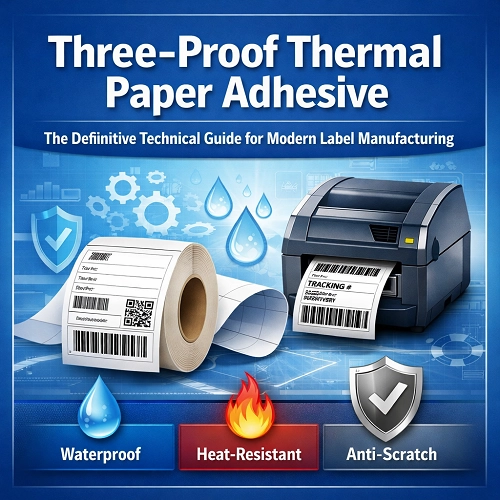
As global supply chains grow more demanding and labeling accuracy becomes mission-critical, Three-Proof Thermal Paper Adhesive has emerged as the standard-bearer for durable, high-performance label bonding. Combining waterproof, oil-proof, and heat-resistant properties in a single engineered formulation, this adhesive category meets the rigorous expectations of logistics, retail, pharmaceutical, and industrial operations worldwide.
Section 01
Thermal paper adhesive is the pressure-sensitive bonding layer applied to the underside of thermal label stock, enabling labels to adhere to packages, containers, and surfaces throughout their operational lifespan. The three-proof designation refers specifically to a formulation engineered to resist three critical environmental stressors simultaneously: water, oil, and elevated heat — the three most common causes of label failure in real-world environments.
Standard adhesives can handle controlled conditions well, but fail when exposed to moisture in transit, grease in food processing, or heat spikes in warehouse environments. Economic Three-Proof Thermal Paper Adhesive from Zhejiang Guanhao closes this gap by employing modified acrylic emulsion or solvent-based polymer chemistry, creating a stable, resilient bond even in harsh operating conditions.
1. Waterproof: Polymer cross-linking prevents adhesive hydration and bond failure even when labels encounter rain, condensation, or humid storage environments.
2. Oil-Proof: Engineered surface energy resists oils, greases, and petrochemical residues common in food processing, automotive, and industrial sectors.
3. Heat-Resistant: Thermally stable formulations maintain adhesion and protect the thermal coating from temperatures ranging from −20°C to 120°C without migration or de-lamination.
Section 02
Understanding the technical profile of a three-proof adhesive is essential for converters, printers, and purchasing managers. The following table presents the full specification profile for Guanhao's Economic Three-Proof Thermal Paper Adhesive:
| Parameter | Specification | Test Standard |
|---|---|---|
| Appearance | Milky white or translucent viscous liquid | Visual inspection |
| Base Composition | Modified acrylic emulsion / solvent-based polymer | GPC / FTIR |
| Viscosity (25°C) | 2,000 – 3,000 mPa·s | Brookfield RV |
| Solid Content | 45% ± 2% | 105°C / 3hr oven dry |
| pH Value | 6.5 – 7.5 | pH meter calibration |
| Peel Strength (90°) | ≥ 15 N / 25mm | ASTM D903 / PSTC-1 |
| Shear Resistance | Excellent — suitable for long-term adhesion | PSTC-7 |
| Operating Temperature | −20°C to 120°C | Thermal chamber cycling |
| Recommended Coat Weight | 20 – 25 g/m² | Gravimetric measurement |
| Drying Conditions | 80 – 100°C with sufficient drying time | In-line IR / hot-air oven |
| Shelf Life | 6 months under proper storage (5 – 35°C) | Accelerated aging |
| RoHS / REACH | Compliant — no heavy metals or restricted solvents | IEC 62321 / SVHC list |
All specifications are verified through batch-level quality control at the Guanhao manufacturing facility in Pinghu City, Zhejiang. Certificates of Analysis (CoA) are available upon request from the Guanhao technical team.
Section 03
What distinguishes three-proof formulations from conventional thermal adhesives is not any single attribute but the synergistic integration of multiple performance properties. The Guanhao thermal adhesive range is engineered so each characteristic reinforces the others.
Section 04
Label buyers and converters are often weighing economic trade-offs between standard adhesive grades and three-proof solutions. The matrix below provides a direct performance comparison across the most operationally significant parameters.
| Performance Criterion | Standard Thermal Adhesive | Three-Proof Thermal Adhesive |
|---|---|---|
| Water Resistance | Limited — bond weakens on wetting | High — polymer cross-linking prevents hydration |
| Oil / Grease Resistance | Poor — adhesive absorbs oils | Excellent — engineered surface energy repels oils |
| High-Temp Stability (>60°C) | Softens, may delaminate | Stable to 120°C continuous |
| Low-Temp Flexibility (<0°C) | Brittle, reduced tack | Functional to −20°C |
| Peel Strength (90°) | 8 – 12 N/25mm (typical) | ≥ 15 N/25mm |
| Print Clarity Retention | Moderate — may fade with moisture | High — thermally inert coating interaction |
| Multi-Surface Bonding | Paper & cardboard preferred | Plastic, metal, glass, cardboard |
| Environmental Compliance | Variable by grade | RoHS & REACH compliant |
| Suitable for High-Speed Lines | Yes (standard grades) | Yes — optimised rheology |
| Recommended Applications | Light-duty indoor labels | Logistics, food, pharma, industrial |
Section 05
The versatility of three-proof thermal adhesive technology allows it to serve a wide spectrum of industries. Each sector imposes distinct environmental demands, and the formulation's multi-protection profile addresses them all. Below is a breakdown of primary application sectors, relevant product links from the Guanhao portfolio, and the specific demand drivers in each industry.
| Industry Sector | Primary Demand Driver | Typical Label Type | Relevant Solution |
|---|---|---|---|
| Logistics & Warehousing | Rain exposure, friction, long transit cycles | Shipping & barcode labels | Logistics Labels |
| Retail & POS | Frequent handling, pricing changes | Shelf & price tags, receipts | Retail Labels |
| Food & Beverage | Moisture, oils, refrigeration | Product & packaging labels | Daily Chemical Labels |
| Pharmaceutical / Healthcare | Sterilisation, chemical exposure, traceability | Drug & laboratory ID labels | Drug Labels |
| Electronics Manufacturing | Solvents, heat during assembly | Component & PCB ID labels | Electronic Labels |
| Automotive / Industrial | Grease, UV, extreme temperature cycling | Tire & parts identification | Tire Labels |
| Water & Beverages | Condensation, ice, wet surfaces | Bottle & container labels | Drinking Water Labels |
| Office / A4 Applications | Flat sheet printing, multi-use office environments | Address, filing & form labels | A4 Flat Sheet Labels |
Section 06
Realising the full performance potential of three-proof thermal adhesive requires adherence to validated application procedures. Deviations in surface preparation, coat weight, or curing conditions are the most common sources of field performance issues.
All application substrates must be free of dust, oil films, and moisture before adhesive contact. Contaminated surfaces reduce effective contact area at the adhesive–substrate interface, directly lowering peel strength. Wipe metal and plastic surfaces with isopropyl alcohol (IPA) and allow to dry fully. Cardboard and paper substrates should be stored at controlled humidity before use.
The adhesive is compatible with roller, blade (comma bar), and spray coating equipment. The recommended coating weight of 20 – 25 g/m² should be maintained through consistent machine settings. Higher coat weights increase peel strength but may compromise drying efficiency; lower weights risk insufficient bond formation on rough or textured surfaces.
Drying at 80 – 100°C is essential for full polymer network formation. Insufficient drying leads to residual moisture in the adhesive film, which can cause adhesion failures in service — particularly in cold-storage logistics chains. In-line IR drying or zone-controlled hot-air ovens are recommended for production environments.
Keep containers sealed and store at 5 – 35°C, away from direct sunlight and freezing temperatures. Under these conditions, shelf life is six months from the production date. Do not thin the adhesive with water or solvents without prior technical approval, as this can alter the viscosity profile and affect coat weight consistency.
For technical queries on application equipment compatibility, custom coat-weight specifications, or material safety data, contact the Guanhao technical support team directly at +86-573-8571-1001.